Born in 1990 in Port-au-Prince, Haiti
Lives and works in Port-au-Prince, Haiti
The work of Shneider Léon Hilaire is deeply infused with the presence of Vodou, introduced to Haiti from Benin by Africans who were enslaved. His practice explores society’s relationship with death. In Vodou belief, beings do not truly die; they watch over and protect the living. The dead are not absent—they are simply invisible.
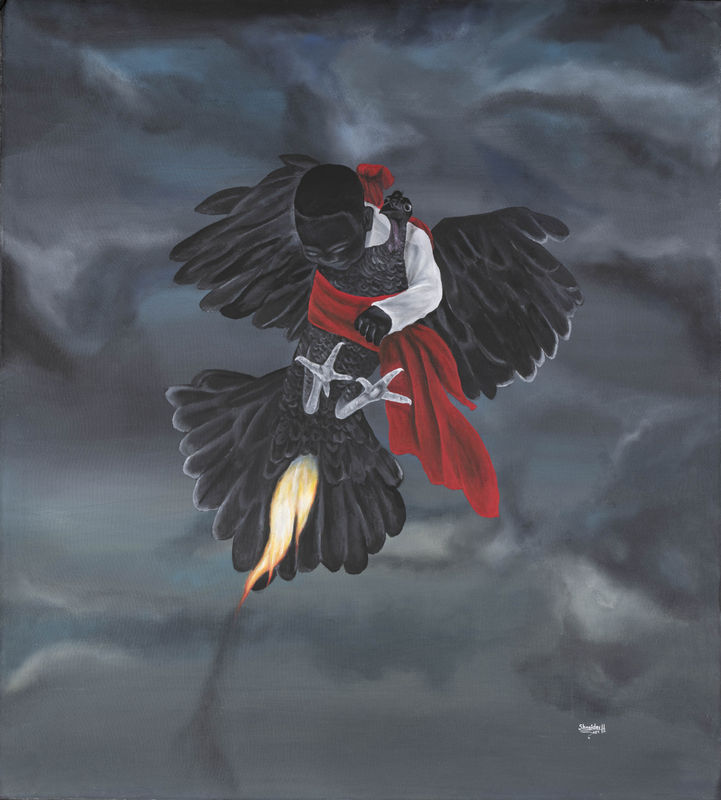
Like a griot transmitting memory, Shneider Léon Hilaire captures on canvas the oral traditions of stories, tales, and legends that he has carefully collected throughout the country. Although he draws inspiration from his daily life, it is above all the collective imagination—beliefs, mythologies, and traditions of the Haitian people—that fuels his creativity.
His current body of work is divided into three major series: Haitian Nights, The Depths of Dreams, and Nou ak sa n pa wè yo (We and the Invisibles).
For the Haitian Nights series, Shneider gathered stories from elders connected to the collective imagination of the night. In the past, these stories were told during communal gatherings, but today, with new technologies, they are gradually disappearing. The aim of this series is to create images based on these testimonies and to share these imaginaries. It is an oral heritage that the artist seeks to preserve through his paintings.
In The Depths of Dreams, the artist presents dreamlike representations of Haitian interpretations of myths and legends.
The series Nou ak sa n pa wè yo (We and the Invisibles) addresses spirits or lwa, ancestors, and the different ways they manifest themselves and influence the daily lives of Haitians.
In his paintings, Shneider does not use a wide range of colors. He favors black and white, which he enjoys working with in transparency, as well as red, blue, and green. These colors serve primarily an expressive rather than a descriptive function, each carrying a particular meaning within the Vodou universe. For example, pink is associated with Freda, the lwa of love and femininity.
Animals are very present in his paintings, always in a symbolic manner. They refer to Vodou imagery, such as the turkey, which symbolizes the werewolf. However, when animals are painted in white and rendered transparently, they represent spirits.